Structure vs. Sequence Homology: Inferring Function When BLAST Comes Up Empty
For decades, the standard way to guess what an unknown protein does was: align its sequence against everything with a known function, find the closest match, and borrow its annotation. That approach has a hard limit — and AlphaFold plus Foldseek is exactly what lets you push past it.
The classical approach — and where it breaks
Beginner
Historically, protein evolution has mostly been studied through this lens: a gene existed in some ancestral organism, got duplicated and inherited across descendant species/lineages, and drifted — accumulating mutations — while (usually) keeping a similar overall shape and function. Sequence alignment exploits this directly: find a sequence similar enough to a query, and you've very likely found a protein with a similar function, because shared sequence is strong evidence of shared ancestry (homology).
This works beautifully for close relatives. It breaks down once sequences have diverged far enough — below roughly 20–25% pairwise identity, often called the "twilight zone," alignment scores become statistically indistinguishable from chance. A huge fraction of "hypothetical protein, function unknown" entries in sequence databases sit exactly in or below this zone: real, functional proteins with no sequence-detectable relatives.
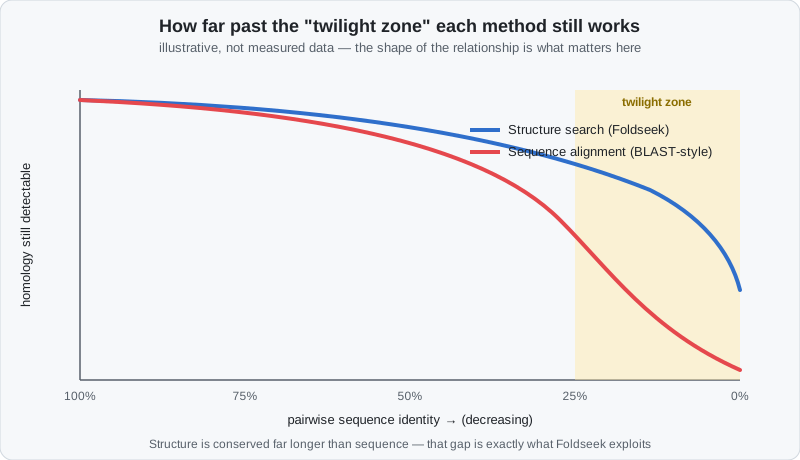
Structure is conserved long after sequence isn't
Advanced: the structure-function principle
Three-dimensional structure evolves far more slowly than sequence. A protein's fold is shaped by physical constraints (what actually stays stable, foldable, and functional) that outlast which specific amino acids happen to occupy which positions — so two sequences can drift into the twilight zone and beyond while the fold itself stays essentially unchanged, because function depends on structure, and structure is what's actually under selection. This is sometimes summarized as the structure-function principle: shape, not sequence identity, is the more direct carrier of biological function.
This is precisely why AlphaFold + Foldseek is such a powerful combination for an unknown protein:
- AlphaFold predicts a 3D structure for essentially any sequence — including ones with zero detectable homologs, where sequence-based tools have nothing to work with.
- Foldseek then searches by structure, not sequence — converting structures into a compact structural alphabet ("3Di") and searching that the way MMseqs2 searches sequences. Published benchmarks show it running four to five orders of magnitude faster than classical structure aligners (Dali, TM-align, CE) while matching or exceeding their sensitivity on standard benchmarks (86–133% relative sensitivity depending on the comparison method) — fast enough to search hundreds of millions of structures, including the entire AlphaFold DB.
Practically: you predict the structure of your mystery protein, search it against structures of proteins with known function, and a confident hit gives you a function hypothesis that sequence search alone would never have surfaced.
Two different reasons two proteins can share a fold
Advanced: don't conflate these
When Foldseek finds a strong structural match with no detectable sequence similarity, there are two distinct evolutionary explanations — worth keeping separate, because they support different conclusions:
- Remote (deep) homology — by far the more common case. The two proteins really do share a common ancestor; the sequence has simply diverged past the point where alignment can detect it, while the fold — under stronger functional/physical constraint — has not. This is the primary phenomenon Foldseek is built to recover: homology relationships real but invisible to sequence-based search.
- True convergent evolution — genuinely independent origins. Two proteins with no shared ancestry independently arrive at a similar structural solution because it's a good (sometimes the only good) way to solve a given physical/chemical problem. This is real, but it's most robustly documented at the level of a local active site or motif rather than an entire global fold. The textbook example: chymotrypsin and subtilisin — completely different overall folds, no detectable sequence homology, yet both independently evolved a near-identical Ser–His–Asp catalytic triad with the same geometric arrangement, because that arrangement is simply an effective solution for that chemistry. A more recent example: the AiiA and PLL lactonase families show closely convergent catalytic mechanisms and active-site architecture despite no fold or sequence similarity at all.
In practice, a Foldseek hit is most often evidence of case one — a real, if extremely old, evolutionary relationship — rather than independent invention. Either way, the functional inference logic is the same: similar structure (especially similar local active-site geometry) is meaningful evidence of similar function, with or without any sequence signal to back it up.
Beyond one search: clustering, and using it without ChimeraX
Advanced: Foldseek is more than a single-query search
Everything above frames Foldseek as "search my one structure against a database," which is what the ChopChopMF workflow does. The underlying Foldseek toolkit does more:
easy-clustergroups a whole set of structures by similarity instead of searching one at a time — useful for deduplicating a large AlphaFold-predicted collection, separating distinct fold families out of a mixed set, or building a non-redundant dataset before downstream analysis. At full scale, this is exactly how the AlphaFold Database's own structures were organized: Foldseek clustered over 214 million predicted structures into roughly 2.3 million clusters — a ~100x reduction — and around 31% of those clusters contained no previously known structure at all ("dark" proteome), a rough indicator of how much structural space was invisible to sequence-based methods alone.easy-multimersearchextends the same idea to protein complexes, comparing multi-chain assemblies and reporting both chain-level and interface-level similarity.- A ProstT5 language-model mode can search directly from a raw sequence — no structure prediction step first — reported as 400–4000x faster than predicting a structure with ColabFold before searching it, at some cost to precision. Useful for extremely large first-pass screens.
Beginner: you don't need ChimeraX or the command line at all
Since September 2024, the AlphaFold Database itself has Foldseek built in — search any AFDB or PDB entry by structure directly from the browser, filter hits by E-value/sequence identity/taxonomy, and visualize alignments colored by pLDDT, no installation required. It searches against AFDB50 (the database pre-clustered at 50% sequence identity, for speed) plus a weekly-updated PDB mirror. The EBI AlphaFold training course walks through reading these results — E-values and RMSD are the two numbers to focus on for judging match quality. Same important caveat as above: structural similarity is strong evidence, not proof, of shared function — always sanity-check a hit against what's actually known about it.
Why this only works on the rigid part of the structure
Expert: structure comparison needs an actual structure to compare
Foldseek — like any structure-alignment method — compares fixed sets of 3D coordinates. That's a well-posed question for a folded, rigid domain, and a poorly-posed one for a genuinely flexible or intrinsically disordered region, which isn't well described by any single structure at all — it's better thought of as an ensemble of many transient conformations, loosely restrained rather than fixed (see What Actually Influences a Prediction? and the discussion of transient helices in Confidence Metrics). Asking "what fold does this disordered loop have?" is a bit like asking a fast-moving quantum particle for its exact position — the premise of a single well-defined answer doesn't hold, not just because measurement is hard (the analogy is illustrative, not a literal physical equivalence, but it captures the idea well).
pLDDT is your practical proxy for "is this actually rigid enough to compare structurally." High-pLDDT regions are AlphaFold's best guess at a genuinely well-defined, stable fold — a meaningful unit to hand to Foldseek. Low-pLDDT regions usually aren't describing one true structure at all, so a structural search over them is comparing noise, not signal.
The practical workflow
Beginner: putting it together
- Predict the structure of your protein of unknown function (AlphaFold/ColabFold).
- Check pLDDT (Confidence Metrics) to find a genuinely rigid, well-folded region.
- Crop out that region with ChopChopMF — see Trimming a model — before searching.
- Run Foldseek against the PDB and/or AlphaFold DB.
- A confident structural hit to a protein with a known, annotated function is a genuine, testable hypothesis for what your unknown protein does.
Crop a real domain, not a single secondary-structure element
Don't crop down to just one helix or one sheet before searching. A single α-helix or β-strand is a generic building block that fits into an enormous number of unrelated folds — searching with one all but guarantees noisy, uninformative hits. Crop a complete structural domain (typically dozens to a few hundred well-folded residues, forming a self-contained fold) — small enough to exclude flexible/disordered material, but large enough to actually encode a distinctive fold. This is the same principle behind ChopChopMF's own crop-before-Foldseek guidance in the Workflows page.
Worked example: cropping BRCA1's own rigid domain
The protein from Try It: A Real Example Protein makes steps 2–3 concrete rather than abstract. BRCA1 (UniProt P38398) is ~80% low-pLDDT/disordered, but its C-terminal tandem BRCT domain (residues 1642–1855 — the single dark block in the real PAE plot on that page) is a genuinely rigid, well-folded unit worth cropping and searching. Note this isn't a zero-sequence-similarity case like chymotrypsin/subtilisin above — BRCT is a well-characterized, sequence-detectable Pfam domain that recurs (with real, if sometimes distant, sequence homology) across other DNA-damage-response proteins such as 53BP1, MDC1 and TopBP1. It's included here as a concrete illustration of cropping a real rigid domain before a structure search, on the exact protein already shown elsewhere in this guide — not as a second convergent-evolution example.
Continue to Reading Confidence Metrics →